Welcome!

By registering with us, you'll be able to discuss, share and private message with other members of CityRP.

SignUp Now!

Case: Pending Azalea Isles v. Daniel Spezi (2026) CR 03

The Court accepts the motion for sanctions. However, given the severity of the charges alleged, the Court will not be proceeding to a default judgement simply because of the Defendant's ineffective counsel.

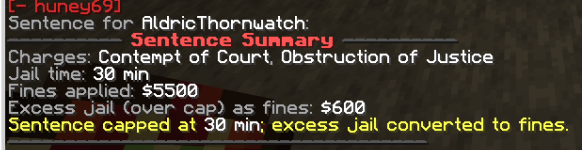
Due to the failure to meet court deadlines despite extensions provided, the Defendant's counsel Dayvon Hamilton (AgentSquid2012), is hereby found in contempt. The Ministry of Justice is asked to apply the appropriate punishment for the first offence of Contempt of Court, pursuant to the New Criminal Code Act.

The Court will ask that the Defendant, Daniel Spezi (Ahrucrafter), finds new counsel or represents himself pro se. A new deadline of 48 hours from this post is provided for the Defence to provide the answer to the complaint. @Ahrucrafter

As Hamilton will no longer be the counsel on record for this case, the Court deems the Prosecution's earlier motions on his conflicts as redundant and moot.


Your Honor, the charge has been executed.

Signed,
Phoenix Flamesong
Deputy Minister of the MOJ
 

Attachments

  • squid_contempt.png
    squid_contempt.png
    88.5 KB · Views: 7
After reviewing the motion to dismiss and the response from the Prosecution regarding the statutory construction of §6(j) Terrorism of the New Criminal Code Act, the Court hereby postpones ruling on the motion pending an opportunity for amendment.

The central question is whether the subsections defining Terrorism under §6(j)(iii) are conjunctive (requiring all elements) or disjunctive (alternative methods). The Prosecution argues that omitting the word "or" was a stylistic choice across the Act, pointing to §6(b) Obstruction of Justice. However, a complete reading of the Act proves this assumption to be less clear than claimed. In some cases, Parliament has provided disjunctive clauses.

For example, a codified crime specified in the same section, §6(f) Impersonation of a Government Official states:
(iii) A person commits an offense if the person:
(1) falsely represents themselves as a government official, or claims to have government official's authority, in order to gain compliance, information, access, money, property, or any other benefit; or
(2) uses government officials powers without lawful authority, including conducting searches, detaining persons, issuing punishments, or ordering citizens to follow directives under the appearance of government officials.

Given the mix of examples, the Court recognizes that the absence of the word "or" does not conclusively establish that subsections (1), (2), and (3) of §6(j)(iii) are conjunctive by itself. Therefore, we cannot rely solely upon comparison with other provisions of the Act to determine legislative intent. However, the structure and wording of §6(j)(iii) leave genuine ambiguity as to whether the three subsections establish cumulative elements or alternative methods of committing terrorism. That ambiguity is particularly significant because this is a criminal provision carrying substantial punishment.

Where a criminal statute is ambiguous, the Court must avoid adopting an interpretation that expands the category of conduct subject to criminal punishment beyond what Parliament has clearly prescribed. Criminal liability cannot be imposed upon an individual based upon an expansive interpretation of uncertain statutory language. Any uncertainty must therefore be resolved in the manner most favourable to the accused. As a result, the Court is applying the rule of lenity. This goes in line with the principle of a reasonable doubt, as the burden is on the government to draft clear laws just as it is for them to prove guilt beyond reasonable doubt.

Applying this rule, the Court will construe §6(j)(iii) conjunctively for purposes of this case only. The Prosecution must therefore allege facts satisfying subsection (1) in addition to the remaining requirements of the provision. This conclusion should not be understood as holding that the omission of the word "or" necessarily establishes a conjunctive reading in every provision of the Act. Rather, the Court reaches this interpretation because of the ambiguity present here and the application of the rule of lenity to a criminal statute.

The Prosecution is granted leave to amend its complaint within 48 hours of this order to explicitly allege and incorporate facts satisfying the organized group requirement under §6(j)(iii)(1). If and only if they cannot, then this case will be dismissed.
 
After reviewing the motion to dismiss and the response from the Prosecution regarding the statutory construction of §6(j) Terrorism of the New Criminal Code Act, the Court hereby postpones ruling on the motion pending an opportunity for amendment.

The central question is whether the subsections defining Terrorism under §6(j)(iii) are conjunctive (requiring all elements) or disjunctive (alternative methods). The Prosecution argues that omitting the word "or" was a stylistic choice across the Act, pointing to §6(b) Obstruction of Justice. However, a complete reading of the Act proves this assumption to be less clear than claimed. In some cases, Parliament has provided disjunctive clauses.

For example, a codified crime specified in the same section, §6(f) Impersonation of a Government Official states:


Given the mix of examples, the Court recognizes that the absence of the word "or" does not conclusively establish that subsections (1), (2), and (3) of §6(j)(iii) are conjunctive by itself. Therefore, we cannot rely solely upon comparison with other provisions of the Act to determine legislative intent. However, the structure and wording of §6(j)(iii) leave genuine ambiguity as to whether the three subsections establish cumulative elements or alternative methods of committing terrorism. That ambiguity is particularly significant because this is a criminal provision carrying substantial punishment.

Where a criminal statute is ambiguous, the Court must avoid adopting an interpretation that expands the category of conduct subject to criminal punishment beyond what Parliament has clearly prescribed. Criminal liability cannot be imposed upon an individual based upon an expansive interpretation of uncertain statutory language. Any uncertainty must therefore be resolved in the manner most favourable to the accused. As a result, the Court is applying the rule of lenity. This goes in line with the principle of a reasonable doubt, as the burden is on the government to draft clear laws just as it is for them to prove guilt beyond reasonable doubt.

Applying this rule, the Court will construe §6(j)(iii) conjunctively for purposes of this case only. The Prosecution must therefore allege facts satisfying subsection (1) in addition to the remaining requirements of the provision. This conclusion should not be understood as holding that the omission of the word "or" necessarily establishes a conjunctive reading in every provision of the Act. Rather, the Court reaches this interpretation because of the ambiguity present here and the application of the rule of lenity to a criminal statute.

The Prosecution is granted leave to amend its complaint within 48 hours of this order to explicitly allege and incorporate facts satisfying the organized group requirement under §6(j)(iii)(1). If and only if they cannot, then this case will be dismissed.
MOTION TO RECONSIDER

Your Honour, the Prosecution would like to motion for reconsideration on your verdict on the motion to dismiss.

There is plenty of precedent for the criminal code to be interpreted as each requirement listed under the phrase "A person commits an offense if the person:" to be independent ways of committing the crime and not requiring conjunction with one another.

In the case Azalea Isles v. Dayvon Parentless (2026) CR 02, the Defendant is found guilty of obstruction of justice, with no evidence, mention, or even a mere suggestion of the second listed way to commit the offense, that being "(2) uses or attempts to use an AWS device-protected restricted area that the person has access to, to prevent a law enforcement officer from lawfully detaining or arresting an individual.". This shows clear precedent of the fact that only a single requirement must be met in order to satisfy the charges.

CO-COUNSEL STATEMENT
Your Honour,

It appears the court misunderstood our filing. Lao19 was supposed to be made a Co-Counsel on this case. The court only recognised Biscuit Cookie as a prosecutor on this case.


Lawfully Signed,
IMG_4024.png
IMG_3946.png
 
ANSWER TO THE MOTION TO RECONSIDER

Your Honour,

This motion is out-of-line. As stated plainly by the Court, the ruling on the motion to dismiss was postponed to give the Prosecution a chance to amend their complaint. The Court explicitly granted the Prosecution leave to amend and made dismissal conditional upon their failure to do so. A Motion to Reconsider should not be permitted to circumvent the procedural framework the Court itself established. The Prosecution must first attempt to amend; only if that fails does the conjunctive interpretation become final and subject to reconsideration.

The Court has already acknowledged the statute's ambiguity and correctly applied the Rule of Lenity. Because subsections (1), (2) and (3) lack the word "or", which Parliament uses explicitly in Section 9(c), the ambiguity is genuine. Given the severity of terrorism charges, the Rule of Lenity applies with even greater force.

The Prosecution has not made any novel arguments in their motion. They merely restate their earlier comparison of Section 6(b)(iii) and Section 6(j)(iii), providing no new legal theory, statutory interpretation, or response to the Court's finding of genuine ambiguity. The Prosecution's burden under the Rule of Lenity is to overcome the Court's conditional ruling with fresh argument, not to recycle prior submissions. They have failed to meet it.

The comparison between the Obstruction of Justice provision and the Terrorism provision fails on its face. The Obstruction of Justice provision defines two methods of committing the same crime, whereas the Terrorism statute provides both the who and the what. Subsection (1) indicates the who; "a person who is part of an organized group". Subsections (2) and (3) indicates the what; "unlawfully uses violence..." and "threatens use of violence..."

Furthermore, in Azalea Isles v. Dayvon Parentless (2026) CR 02, the Court did not make a ruling in favour of the disjunctive reading of subsections (1) and (2) of Section 6(b)(iii) of the New Criminal Code Act ("NCCA"). Instead, the ambiguity was unaddressed. We have to look no further than Section 9(c) of the NCCA for an example of Parliament using clear disjunctive text to indicate that either subsections may apply for a person to have committed the offense of Insider Trading. Section 9(c) proves that disjunctive language is intentional, not stylistic.

In the face of the Rule of Lenity, it is the Prosecution's burden to prove that the ambiguity is resolved in their favour. They have failed to do so. A mere restatement of their previous argument fails that burden.
 
Back
Top