


- Joined
- Nov 15, 2025
- Messages
- 6
- Thread Author
- #1
Anthony Org, Plaintiff
v.
Azalea Isles, Defendant
v.
Azalea Isles, Defendant
Civil Complaint:
Plaintiff Anthony Org, an MP and sponsor of the “Real Crime Crackdown Act,” brings this civil action because the Speaker of Parliament unilaterally opened debate on Plaintiff’s bill without Plaintiff’s notice or consent, then moved to terminate debate almost immediately while disparaging the bill. Plaintiff alleges the Speaker acted ultra vires under the Parliamentary Procedure Act (“PPA”), violated statutory duties of fairness and impartial enforcement of parliamentary procedure, and engaged in unconstitutional government overreach. Plaintiff seeks declaratory judgment, injunctive relief, nominal damages, and legal fees.
Parties:
- Plaintiff: Anthony Org (IGN: "Anthony_org")
- Defendant: Azalea Isles (including Parliament for purposes of institutional relief)
- Co-Defendant(s): Octavian Russell (IGN: "Methedex"), in his official capacity as Speaker of Parliament
Factual Allegations:
(All dates and times are in Eastern Standard Time, which is UTC-5. Except where otherwise stated, times refer to times on February 19, 2026.)- Plaintiff is a member of Parliament and a citizen of the Azalea Isles.
- The Plaintiff’s timezone is Eastern Standard Time.
- Plaintiff is the listed author of the Real Crime Crackdown Act, which Plaintiff introduced at 1:57 AM on Thursday, February 19, 2026 (Exhibit P-004).
- The Real Crime Crackdown Act was edited by Plaintiff at 2:14 AM.
- Co-Defendant Octavian Russell (ign: Methedex) is the Speaker of the Parliament and a citizen of the Azalea Isles.
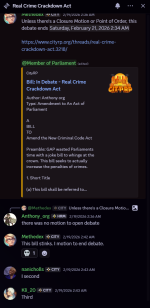
- At approximately 2:36 AM, Mr. Russell asserted that debate on the Real Crime Crackdown Act had opened and set a default debate end time absent further motions (Exhibit P-001).
- Shortly thereafter, and in the same minute, Plaintiff replied to Mr. Russell’s post by stating that “there was no motion to open debate” (Exhibit P-001).
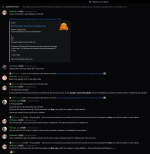
- At approximately 2:37 AM, Mr. Russell stated: “I have motioned to open debate on this bill” and linked Plaintiff’s bill thread. (Exhibit P-002)
- Shortly thereafter, MP Nanichols Nanichols stated: “I agree! We must hear about this real crime!” (Exhibit P-002)
- Another MP, Mr. Aero Nox, stated: “Next time, please do it in the right order” (Exhibit P-002).
- At approximately 2:38 AM, Plaintiff replied to a message by Mr. Russell quoted the PPA’s “Proposing Bills” section—specifically that once the bill is proposed “they can notify the speaker to open debate”—and stated plainly: “I have not moved to put my bill up for debate.” (Exhibit P-002)
- The Plaintiff did not want the Speaker to open debate on the Real Crime Crackdown Act at that time.
- At approximately 2:39 AM, Mr. Russell responded that he could proceed without Plaintiff’s notice, stating: “I am the speaker i need not notify myself to open a debate”, and further asserted that anyone can ask to have a proposal opened for debate “even if it’s not yours.” (Exhibit P-002)
- At approximately 2:42 AM, still on February 19, 2026, Mr. Russell publicly disparaged Plaintiff’s bill and initiated a shutdown of debate: “This bill stinks. I motion to end debate.”
- Within two minutes after Mr. Russell’s comment mentioned in the immediately preceding factual allegation, Mr. Nanichols Nanichols responded: “I second.” (Exhibit P-001)
- At approximately 2:45 AM, a formal “Motion to end debate on the Real Crime Crackdown Act” was posted, reflecting that Mr. Russell and Mr. Nanicholls had motioned to end debate. (Exhibit P-003)
- Within 5 minutes, 5 members of parliament voted in the affirmative on the motion to end debate. (Exhibit P-003)
- In this whole time, Plaintiff never asked nor directed the Speaker to open debate on the Real Crime Crackdown Act.
- Mr. Russell, prior to all this, had introduced the Crime Crackdown Act to the Parliament about two hours prior to the posting of the Real Crime Crackdown Act (Exhibits P-004, P-005).
- The Crime Crackdown Act addressed the issue of crime, but generally contained harsher penalties than those in the Real Crime Crackdown Act (Exhibits P-004, P-005).
- The Crime Crackdown Act was eventually passed by the Parliament and granted royal assent (Exhibit P-005).
- At all times relevant to this case, Mr. Russell preferred the passage of the Crime Crackdown Act to that of the Real Crime Crackdown Act.
- Mr. Russell failed to impartially enforce the Parliamentary Procedure Act with respect to the Real Crime Crackdown Act.
- Mr. Russell failed to maintain fairness in debates and on the floor of the Parliament with respect to his handling of the Real Crime Crackdown Act as Speaker.
Legal Claims:
I. The Speaker violated the Parliamentary Procedure Act and the Constitution when handling floor and debate proceedings on the Real Crime Crackdown Act.
I.1 General Legal Background: Parliamentary Procedure and Constitution.
The Constitution tasks the Parliament “with the authority to make laws, levy taxes, and oversee the functioning of the government” (Const., Article 2). As one of the three co-equal branches, the Parliament has “the quasi ability to fulfil obligations necessary for the performance of laws, given those laws are within the bounds of the constitution, and in nature constitutional” (Const., Article 2).To function orderly and according to clear rules, the Parliament adopts legislative procedure. At times this is done through law, such as the Parliamentary Procedure Act (hereafter, the PPA). At other times, this has been done through Standing Orders (c.f. Continuity Act, Section 2(f); PPA, Section 9(b)(3); Orderly Parliament Act, Repeal No. 2).
The District Court has long- acknowledged “right of the Parliament to set its own procedures” (Crumplesnatch v. Azalea Isles (2025) CV 02). To do this, the Parliament has enshrined several key procedures into law through the Parliamentary Procedure Act, particularly so after the amendments from the Orderly Parliament Act. This includes, among other items, the process for Proposing Bills (PPA, Section 5), engaging in Parliamentary Debate (PPA, Section 7), and procedures for voting (PPA, Section 8).
I.2 Further Background: Responsibilities and Duties of the Speaker.
To enforce these parliamentary rules, the Constitution vests power in a Speaker of the Parliament (Const., Article 3), whose election is subject both to law and “legislative procedure” and whose responsibilities are “maintaining decorum within the chamber and managing voting protocols”. The Parliament has further specified additional powers of the Speaker in statute, and imposes three duties upon the Speaker within Section 9(b) of the PPA:(i) Conducting and facilitating the parliamentary business including voting
(ii) Maintaining order and fairness in debates and the floor.
(iii) Enforcing the Parliamentary Procedure Act, Standing Orders, and general ethical standards in an impartial manner.
For this claim, the Plaintiff alleges that the Speaker acted against procedure (and, thus, ultra vires) with regards to the handling of the proposed Real Crime Crackdown Act. Now that we know the issue, we should proceed to understanding what the relevant rule is: what are the current procedures, and how does that relate to this case?
I.3 Parliamentary rules, as established in the PPA, require the Speaker to be notified by a bill’s introducing MP prior to opening debate on that bill.
Every member of Parliament is empowered to introduce their own legislation (PPA, Section 5(a)). This may be done by placing a bill draft onto the Bill Proposals forum (see, for example, Exhibit P-004). Thereafter, “[o]nce this has been done the bill is proposed and they can notify the speaker to open debate” (PPA, Section 5(b), emphasis mine). After receiving this notification, the Speaker may open debate (PPA, Section 7(a), “[a]ny bill that is introduced will be considered by the house as soon as the speaker opens the debate. Once the debate has opened members will be notified by the speaker”). Debate continues until either a closure motion is passed (PPA, Section 7(b,d)) or voting begins following 48 hours of debate (PPA, Section 7(c)).In this case, the Plaintiff alleges that the Speaker placed the Real Crime Crackdown Act, which the Plaintiff introduced, up for debate without receiving notification from the Plaintiff to do so (Factual Allegations 2, 5, 6, 16). Upon being challenged, the Speaker maintained that the Speaker put it up on his own accord and did not need to notify themself to put the bill up for debate (Factual Allegations 10, 11; Exhibit P-002).
So where does the disagreement that is at the locus of this dispute come from. First, the Speaker erred in assessing who “they” in PPA Section 5(b) refers to. As must interpret each clause in a bill as having a real effect (see: Luke Thegreatfired v. Lysander Lyon (2026) CV 09, Order of Dismissal, “Considering the principle of the anti-surplusage canon, statutes must be interpreted so that every provision has effect”), and in the greater structural context of the law, the answer is clear: the use of “they” in PPA Section 5(b) is a singular they that refers to the same “member” who acted to introduce a bill under PPA Section 5(a). The member who introduces a bill notifies the Speaker when the bill is ready for debate, and the Speaker thereafter will open debate.
The Speaker disagreed, bolding “they can” in the text of PPA Section 5(b) in responding to the Plaintiff and implying that the clause is read in a broadly permissive way that gives the Speaker ultimate discretion over when to start debates of his own accord (Exhibit P-003). But even permissive phrasing can create a sponsor-controlled trigger; reading 5(b) as non-limiting risks voiding the function of the sponsor-notification clause entirely. The District Court has expressly applied anti-surplusage reasoning to avoid interpretations that nullify statutory text (see: Luke Thegreatfired v. Lysander Lyon (2026) CV 09, Order of Dismissal); the Speaker’s reading would do nothing short of de facto nullifying the statutory handshake between the MP and the Speaker. The Speaker's reading, thus, is plain error. Such attempts to relegate statutory text to surplus hold no water in the District Court.
I.4 By starting debate without notification from the Plaintiff, the Speaker acted ultra vires in a way that materially impacted the Plaintiff under both statute and the constitution.
The Plaintiff is a Member of Parliament who wrote and introduced the Real Crime Crackdown Act. Under PPA Section 5(b), the Speaker should not have put the bill up for debate prior to receiving a notification to do so. By doing so anyway, the Speaker short-circuited the Plaintiff in the wee hours of the morning, depriving the Plaintiff of the ability to speak with other MPs and lobby on behalf of his bill.Why did the Speaker do this? The Speaker also had his own bill on the floor at the time that addressed a similar subject matter (Exhibit P-005). The Speaker introduced it about 2 hours before the Plaintiff introduced the Real Crime Crackdown Act. What were the Speaker’s thoughts on the Plaintiff’s bill? The thoughts were simple: he said “This bill stinks” (Exhibit P-001) and then motioned to close debate a mere 6 minutes after opening it unilaterally. The Speaker’s motive to shut down the bill is quite clear.
This is a clear-cut violation of the Speaker’s duty to “maintain[]... fairness in debates and the floor” (PPA Section 9(b)(2)) and to “[e]nforc[e] the Parliamentary Procedure Act… in an impartial manner” (PPA Section 9(b)(3)). The Speaker must not be allowed to bypass statutory rules that a MP to provide notice to the Speaker when their bill is ready for debate, ignore furious objections from that MP who protested that he had not notified the Speaker that the bill was ready for debate, and then almost immediately move to shut down the debate because of dislike of that bill. MPs, like the Plaintiff, are entitled to basic fairness and impartiality from the Speaker in administering the rules; failure to do so causes a violation of statutory rights, especially when ultra vires actions were the immediate cause of the unfairness.
To make matters worse, the Constitution provides citizens “[t]he right against government overreach of powers not specified by the constitution” (Const. Article 1, Section 10). If the speaker were to have overreached here by violating statute-enshrined procedure in a manner that were to harm an MP’s ability to execute their job, it would cause constitutional injury (as do all such ultra vires actions).
I.5 The District Court has authority to oversee legal disputes arising from a Speaker’s failure to faithfully adhere to parliamentary procedure.
In Crumplesnatch v. Azalea Isles (2025) CV 02, the defense raised a separation of powers objection (i.e., that standing orders/parliamentary procedure are internal and not reviewable). The court nevertheless indicated it could determine whether parliamentary procedures were complied with, addressing Speaker obligations under the Parliamentary Procedure Act and providing concrete remedial direction (including directing Parliament to clarify procedure and discounting an improper deciding vote).And in Crumplesnatch v. Bezzer (2024) CV 02, the court entered a default judgment that included the removal of the Speaker based on unlawful voting—demonstrating that the judiciary, at least in some procedural contexts, will impose direct consequences for procedural illegality tied to Speakership conduct.
I.6 Conclusion 1: The Speaker unlawfully acted outside of his authority in unilaterally opening debate on the Real Crime Crackdown Act.
Section 5 of the PPA contemplates a sponsor-controlled trigger to open debate; that is, notification of the speaker. Defendant’s opening of debate absent Plaintiff’s notification/request exceeded Defendant’s authority under the Act and is unlawful.The Parliamentary Procedure Act (PPA) provides that once a bill is proposed, “they can notify the speaker to open debate.” Plaintiff alleges “they” refers to the bill’s proposer/sponsor, and that the Speaker’s unilateral opening—absent Plaintiff’s notice—was not authorized by statute and therefore ultra vires.
This court has previously “acknowledge[d] the importance of maintaining procedural continuity to ensure fairness and stability in the legislative process” (Crumplesnatch v. Azalea Isles (2025) CV 02, Court Opinion, Section 1), as well as the “the critical importance of maintaining public confidence in the integrity of parliamentary procedures” (ibid, Section 2). By failing to adhere to parliamentary procedures, the Speaker has undermined confidence in the integrity of parliamentary procedure, deprived the Plaintiff of the ability to begin debate when the Plaintiff was ready to do so, and violated the statutory scheme that the Parliamentary Procedure Act has laid out. In acting ultra vires, the Speaker also violated the Plaintiff’s right against government overreach.
In short, the Speaker acted outside of his lawfully granted authority, and in doing so materially impacted the Plaintiff as an MP. This injury is cognizable and deserves relief.
I.7 Conclusion 2: The Speaker unlawfully failed to maintain fairness and impartiality when handling the Real Crime Crackdown Act.
The PPA imposes duties on the Speaker to conduct parliamentary business and maintain order and fairness (PPA Section 9(b)(2-3)). Opening debate without ‘s prior notice and then more or less immediately moving to end debate—after publicly disparaging the bill and having proposed a different bill on a similar subject matter—breaches those duties and demonstrates partial, outcome-driven administration. This creates a cognizable injury that warrants relief.II. Nominal Damages
Under the Guiding Principles of Civil Dispute, nominal damages are “awarded to a plaintiff in instances where the statutory law or common law can provide no other monetary equity or award for damages”. In this case, Plaintiff’s statutory and constitutional rights were violated (see generally: Legal Claims, Section I), and thus Plaintiff is entitled to an award of nominal damages to recognize such violations.III. Legal Fees
Under the Damages Reform Act that "[t]he judiciary of the Azalea Isles shall recognize a minimum legal cost of $1,000 per week incurred by parties represented by a lawyer in a trial". Plaintiff is represented by counsel in this case and intends to seek legal fees.Prayer for Relief:
Plaintiff prays that this Court issue the following relief:- Declaratory Judgement.The Plaintiff prays that the Court declare the following:
- That under Parliamentary Procedure Act §5(b), opening debate on a proposed bill requires notification/request by the bill’s introducer/sponsor, and that the Speaker lacks authority to open debate absent such notification/request.
- That co-defendant’s opening of debate and/or placement of Plaintiff’s Real Crime Crackdown Act into “In Debate” status absent Plaintiff’s notification, request, or consent was ultra vires, unlawful, and without legal force.
- That co-defendant unlawfully failed to maintain fairness and impartiality when handling the Real Crime Crackdown Act as Speaker.
- Emergency Injunctive Relief. Issue a temporary injunction immediately maintaining the status quo pending final resolution, including prohibiting commencement of voting and prohibiting any other procedural step that would move Plaintiff’s bill toward voting based on the unlawfully opened debate period.
- Permanent Injunctive Relief. Issue a writ of mandamus and/or permanent injunction compelling Defendant to (a) restore the Real Crime Crackdown Act to its lawful pre-debate status and (b) refrain from opening debate on any bill absent sponsor notification/request as required by the Parliamentary Procedure Act.
- Nominal damages. Award nominal damages in the amount of $750 (or such amount as the Court deems just) for the violation of Plaintiff’s legal rights.
- Legal Fees. Award Plaintiff legal fees and costs in an amount the Court deems reasonable and just, in line with the standard under the Damages Reform Act that "[t]he judiciary of the Azalea Isles shall recognize a minimum legal cost of $1,000 per week incurred by parties represented by a lawyer in a trial".
- Other equitable relief. Grant such other and further relief as the Court deems just and proper.
Evidence

See attached PDF: “Exhibit P-004 - Real Crime Crackdown Act”
See attached PDF: “Exhibit P-005 - Crime Crackdown Act”