Welcome!

By registering with us, you'll be able to discuss, share and private message with other members of CityRP.

SignUp Now!

Case: Pending Budgiebud v. Ministry of Justice (2026) CV 06

Anthony_org

Member
Anthony_org
Anthony_org
Citizen
Joined
Nov 11, 2025
Messages
43

Budgiebud

v.

Ministry of Justice

INTRODUCTION

This civil action arises from the unlawful arrest, detention, and incarceration of Plaintiff Budgiebud by employees of the Ministry of Justice (“MoJ”) without due process of law. Plaintiff was jailed without a hearing, without an opportunity to defend themselves, and under a presumption of guilt rather than innocence.

These actions violated the Constitution of Azalea Isles, specifically:
  • Article 1, Section 9 – Right to self-representation or counsel in a court of law
Plaintiff brings this action to protect constitutional rights and to prevent continued abuse of executive authority by the Ministry of Justice.


PARTIES

Plaintiff:
Budgiebud

Defendant:
The Ministry of Justice

STATEMENT OF FACTS
  1. On 1/9/2026, Plaintiff was arrested by employees of the Ministry of Justice.
  2. Plaintiff was immediately jailed without:
    • a judicial hearing,
    • a formal charge being adjudicated by a court,
    • or an opportunity to defend themselves.
  3. No court order authorizing incarceration was issued prior to Plaintiff being jailed.
  1. Plaintiff was treated as guilty upon arrest.
  2. Plaintiff was not afforded the presumption of innocence.
  3. No opportunity was provided to present evidence or challenge the allegations prior to punishment.

LEGAL CLAIMS
  1. Plaintiff was denied the opportunity to represent themselves or obtain counsel before incarceration.
  2. Punishment was imposed prior to any judicial process.
  3. This conduct violates Article 1, Section 9 of the Constitution of Azalea Isles.

DAMAGES
  1. As a direct result of Defendant’s actions, Plaintiff suffered:
    • unlawful loss of liberty,
    • emotional distress,
    • reputational harm,
    • deprivation of constitutional rights.
    • $300 Azalean Dollars

PRAYER FOR RELIEF


Plaintiff respectfully requests that this Court:
  1. Issue a judicial finding that the Ministry of Justice violated:
    • Article 1, Section 9 of the Constitution of Azalea Isles;
  2. Declare Plaintiff’s arrest and incarceration unconstitutional;
  3. Award compensatory damages in an amount determined by the Court;
  4. Award punitive damages in the amount of $10,000;
  5. Grant injunctive relief preventing MoJ personnel from:
    • incarcerating citizens without judicial adjudication,
    • presuming guilt prior to trial;
  6. Grant any further relief the Court deems just and proper.

I, Anthony_org, hereby affirm that the allegations in this complaint AND all subsequent statements made in court are true and correct to the best of my knowledge, information, and belief, and that any falsehoods may bring the penalty of perjury.

1768019183868.png
 

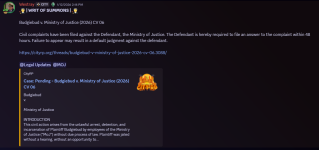
Writ of Summons

Azalea Isles District Court, Civil Case (CV)


Case No. CV-26-06
Plaintiff: No Name (Budgiebud)
Defendant: Ministry of Justice
The Defendant is required to appear before the court in the case of Budgiebud v. Ministry of Justice. Failure to respond within 48 hours may result in a default judgement. Both parties are ask to familiarize themselves with the relevant court documents, including proper formats, as well as the laws referenced in the complaint. Ensure that you comply with any court orders.

If you wish to hold this trial at the Azalea Courthouse in-person, please note that in your response. The Court will try to work with both parties to hold live hearings at convenient times.
Signed,
Hon. Chief Justice Raymond West
 

MOTION FOR DEFAULT JUDGEMENT

Your Honor, The Defendant has failed to appear and answer the complaint within 48 hours of summons. The Plaintiff moves for default judgement against the defendant.
 
Motion to Extend

Your Honour,

The Defense would like to extend the period for providing an answer to the complaint with an additional 24 hours. During the last week the Ministry was hit with a wave of lawsuit unprecedented in the recent past, so that this complaint has been overlooked unfortunately although I cared to check every single case multiple times to ensure this would not happen. Additionally, I was hit with a short notice appointment yesterday so that I was unable to concentrate on writing a response or even appoint another Goverment Prosecutor.
I assume that it would also be in Your Honour's interest to have more time to work on the other trials. I will also assure that from now on every other Motion to Extend will be proposed in a timely manner.

A response to the case file will be provided as soon as possible, in less than 24 hours.
 
OBJECTION

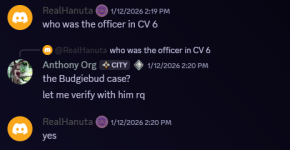
Your Honor, the defense has responded over 24 hours after the motion for default judgment, asking for their deadline to be extended by another 24 hours. This is over 2 times longer than was originally permitted. The Writ of summons was posted in #gov-announcements on 1/12 2:14pm (est) and Defense has acknowledged CV6 in a MoJ ticket on 1/12 2:19pm (EST). Defendant was aware of the case 5 minutes after the writ of summons. Plaintiff moves for Defenses motion to extend to be denied and for default judgement to be awarded.

1768506183269.png1768506200570.png
 
Motion to Extend

Your Honour,

The Defense would like to extend the period for providing an answer to the complaint with an additional 24 hours. During the last week the Ministry was hit with a wave of lawsuit unprecedented in the recent past, so that this complaint has been overlooked unfortunately although I cared to check every single case multiple times to ensure this would not happen. Additionally, I was hit with a short notice appointment yesterday so that I was unable to concentrate on writing a response or even appoint another Goverment Prosecutor.
I assume that it would also be in Your Honour's interest to have more time to work on the other trials. I will also assure that from now on every other Motion to Extend will be proposed in a timely manner.

A response to the case file will be provided as soon as possible, in less than 24 hours.

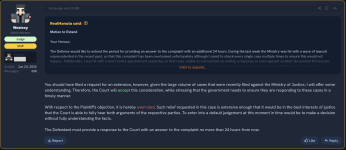
You should have filed a request for an extension, however, given the large volume of cases that were recently filed against the Ministry of Justice, I will offer some understanding. Therefore, the Court will accept this consideration, while stressing that the government needs to ensure they are responding to these cases in a timely manner.

With respect to the Plaintiff's objection, it is hereby overruled. Such relief requested in this case is extensive enough that it would be in the best interests of justice that the Court is able to fully hear both arguments of the respective parties. To enter into a default judgement at this moment in time would be to make a decision without fully understanding the facts.

The Defendant must provide a response to the Court with an answer to the complaint no more than 24 hours from now.
 
Answer to Civil Complaint:
Your Honor,
prior court precedent and technological advancements are both important aspects of this case, as we will show. The Plaintiff was not denied his right to self-representation in a court of law, as evidenced by the fact Plaintiff currently has representation in this court. The Plaintiff's claims do not center around this constitutional freedom, but instead center around the ability of the police to know the Plaintiff's guilt. Furthermore, the Ministry of Justice made a reasonable effort to prevent this incident from occurring, via internal announcement.


Parties

Plaintiff - BudgiebudDefendant -
Ministry of Justice

Factual Defenses or Challenges:

(1) The Ministry of Justice internally ordered a suspension of arrests pending legislative reform and legal challenges, on January 8th, in an attempt to prevent further arrests from occurring. Some officers mistakenly believed a following announcement from an administrator had resolved these issues.

(2) The police plugin not only detects when a player kills another player, but also detects who initiated the fight, so that individuals who engage in self-defense after being assaulted do not have a warrant issued under the plugin.

(3) Police officers cannot jail an individual who does not have at least one active warrant.


Legal Defenses or Challenges

(1) The warrants issued by the police plugin are only issued when the crime is committed, and are the only way officers can actually jail an individual. They are arrest warrants. Arrest warrants being issued via plugin is not new; the previous police plugin recorded crimes and assigned heat to the individuals who committed them, allowing officers the opportunity to arrest the criminals so long as the heat was active. The Court Orders, Powers, and Judgements page, which contains the Arrest Warrant description, has been in existence since the beginning of the server, and yet plugin-issued warrants have worked in conjunction as arrest warrants without issue since then. As such, these warrants deserve to be treated as valid arrest warrants.

(2) Legal Defense #1 is supported by prior precedent. Most recently, it is in line with Judge Wolfe's ruling in Robi Hawes v. Ministry of Justice - "An arrest warrant is not a suspicion that a person may have committed a crime, it is treated as a truth given to officers that the person did commit that crime, and gives them the legal authority to arrest that person." Judge Wolfe's ruling treated the plugin-issued warrants as valid arrest warrants, which makes sense given what we outline in Legal Defense #3.

(3) Legal Defense #1 also aligns with longstanding precedent going back to Azalea Isles v. Krix. The original crime watcher system gave "heat" to individuals for committing crimes, and police officers were able to arrest them while the heat was active. As Judge Milk Crack put it in that case, "...the Crime-Watcher system can be utilized to establish the mens rea (guilty mind) element of the robbery charge..." While the crime watcher system could not confirm a dollar amount stolen, and could not confirm the actual act of robbery - robbery is not under dispute here. The plugin records player-versus-player killings, including who initiated the fight. The Plaintiff’s murder arrest warrant exists because the Plaintiff initiated a fight and killed another player, which establishes not only mens rea (the guilty mind), but also actus reas (the guilty act).

(4) A presumption of innocence is not applicable here, as the tools provided to the Government and the Ministry of Justice are clearly defined as recording who initiated the fight, and any subsequent killing that occurs by the initiator, which is murder. The integration of the police plugin with arrest warrants is consistent with the history of the Azalea Isles, going back a significant span, and is more advanced now than it used to be.

(5) All this, in combination with the Ministry of Justice’s attempt to preclude further arrests, which was partially disrupted due to administrator announcements, shows a Ministry of Justice that has been consistent with prior applications of the law. The plugin demonstrates guilt; the punishment is clearly defined; the warrant is issued from the plugin; there is no need for judicial involvement to confirm a pre-defined punishment for a crime confirmed to have occurred via plugin. Thus, the Defendant should not be ruled against, due to making a reasonable effort to prevent the situation from occurring, and due to operating within the bounds of longstanding legal precedent.

Verification
I, Hanuta Brehmer, hereby affirm that the allegations in the answer AND all subsequent statements made in court are true and correct to the best of the defendant’s knowledge, information, and belief and that any falsehoods may bring the penalty of perjury.
 
OBJECTION
Your honor, your court order said "The Defendant must provide a response to the Court with an answer to the complaint no more than 24 hours from now." The Defense was late to this deadline as shown in the provided screenshots. at 6:27pm EST the defendants post was posted 1 minute ago. This is more than 24 hours after the courts deadline posted at 6:25pm EST. Plaintiff moves for the Defenses filing to be struck and for default judgement to be awarded.
 

Attachments

  • Screenshot 2026-01-16 at 6.27.25 PM.png
    Screenshot 2026-01-16 at 6.27.25 PM.png
    836.2 KB · Views: 5
  • Screenshot 2026-01-16 at 6.28.15 PM.png
    Screenshot 2026-01-16 at 6.28.15 PM.png
    407.6 KB · Views: 5
Response to Objection

This is a screenshot from another player on the server that shows the screenshot being posted within 24 hours' time, Your Honor.
 

Attachments

  • TimeProof1.png
    TimeProof1.png
    198.4 KB · Views: 8
  • TimeProof2.png
    TimeProof2.png
    201.5 KB · Views: 8
prior court precedent and technological advancements are both important aspects of this case, as we will show. The Plaintiff was not denied his right to self-representation in a court of law, as evidenced by the fact Plaintiff currently has representation in this court. The Plaintiff's claims do not center around this constitutional freedom, but instead center around the ability of the police to know the Plaintiff's guilt. Furthermore, the Ministry of Justice made a reasonable effort to prevent this incident from occurring, via internal announcement.
MOTION TO STRIKE
Plaintiff respectfully moves this Court to strike the Defendant’s assertion that Plaintiff was not denied constitutional rights because Plaintiff “currently has representation in this court.”

Plaintiff’s claim does not concern access to the Court after the fact. It concerns the absence of judicial process at the time of arrest and incarceration.

Under the Defendant’s reasoning, an unlawful deprivation of liberty would become lawful so long as an alleged criminal sues afterward. Constitutional protections do not operate in this manner; due process must precede incarceration, not follow it.

This argument does not contest the facts alleged, does not address the legality of the incarceration, and does not constitute a valid defense. It merely attempts to conflate post-violation litigation access with pre-deprivation constitutional process.

MOTION TO STRIKE

Plaintiff respectfully moves this Court to strike the Defendant’s following statement:

“(1) The Ministry of Justice internally ordered a suspension of arrests pending legislative reform and legal challenges, on January 8th, in an attempt to prevent further arrests from occurring. Some officers mistakenly believed a following announcement from an administrator had resolved these issues.”

Internal communications, mitigation efforts, or confusion do not alter constitutional obligations. Such assertions are irrelevant to whether a constitutional violation occurred.

Allowing these statements to remain improperly suggests that intent or internal policy excuses unlawful detention.

MOTION TO STRIKE

Plaintiff respectfully moves this Court to strike the Defendant’s following statement:
“Police officers cannot jail an individual who does not have at least one active warrant.”

This assertion is legally irrelevant.

The issue before the Court is not whether a warrant existed, but whether the warrant constituted lawful authority to incarcerate without judicial adjudication. A warrant’s existence does not resolve its constitutional sufficiency.

MOTION TO STRIKE

Plaintiff respectfully moves this Court to strike the Defendant’s following statement:
“…there is no need for judicial involvement to confirm a pre-defined punishment for a crime confirmed to have occurred via plugin.”

This statement directly contradicts the constitutional role of the Judiciary.

Article 5 assigns courts the responsibility of adjudicating criminal matters and rendering verdicts.

Allowing this statement to remain would nullify the separation of powers.

MOTION TO STRIKE

Plaintiff respectfully moves this Court to strike the Defendant’s following statement:
“The integration of the police plugin with arrest warrants is consistent with the history of the Azalea Isles.”

Historical practice does not override constitutional structure.

Article 7 establishes the exclusive mechanism for altering constitutional requirements. Assertions that longstanding practice validates unconstitutional conduct are legally invalid and misleading.

MOTION TO STRIKE

Plaintiff respectfully moves this Court to strike the Defendant’s following statement:

“The police plugin not only detects when a player kills another player, but also detects who initiated the fight, so that individuals who engage in self-defense after being assaulted do not have a warrant issued under the plugin.”

This statement is immaterial.

Plaintiff does not dispute the method by which evidence may be recorded. The Complaint challenges the absence of judicial adjudication prior to incarceration, not the accuracy or sophistication of investigative tools.

MOTION TO STRIKE

Plaintiff respectfully moves this Court to strike the Defendant’s following statement:

“Police officers cannot jail an individual who does not have at least one active warrant.”

This assertion is legally irrelevant.

The issue before the Court is not whether a warrant existed, but whether the warrant constituted lawful authority to incarcerate without judicial adjudication.

MOTION FOR SANCTIONS

Plaintiff respectfully moves for the Court to issue sanctions against the Defendant. The Defense has missed multiple deadlines and has posted a response that has multiple immaterial statements that are irrelevant to this case.
 
OBJECTION
Your honor, your court order said "The Defendant must provide a response to the Court with an answer to the complaint no more than 24 hours from now." The Defense was late to this deadline as shown in the provided screenshots. at 6:27pm EST the defendants post was posted 1 minute ago. This is more than 24 hours after the courts deadline posted at 6:25pm EST. Plaintiff moves for the Defenses filing to be struck and for default judgement to be awarded.
On my screen, it appears as 6:25pm for the Defendant's post. While I do agree this is erring on the side of trying to skirt the deadline, I am not going to penalize someone for being within a few minutes of the deadline. Therefore, this objection is hereby overruled and the motion to strike is denied.

Regarding the other objections, I wish to point to my recent remarks in the ongoing case of Tomasi Latutupou v. Blogy Wogy (2026) CV 07. An answer to a complaint is the Defendant's initial position with respect to the allegations asserted. Objections or motions to strike based on relevance, hearsay, and an overly argumentative statement are premature where the Defendant has not yet had an opportunity to present its full case. The Court cannot adjudicate disputed factual assertions at the pleading stage.

I will still consider each motion to strike individually, but per my above statement I caution using these motions when a rebuttal would suffice. Here are the following responses:

MOTION TO STRIKE
Plaintiff respectfully moves this Court to strike the Defendant’s assertion that Plaintiff was not denied constitutional rights because Plaintiff “currently has representation in this court.”

Plaintiff’s claim does not concern access to the Court after the fact. It concerns the absence of judicial process at the time of arrest and incarceration.
This motion to strike is hereby accepted.

The complaint concerns whether Plaintiff was afforded due process at the time of arrest and incarceration, not whether Plaintiff later obtained access to the courts. Post-deprivation access to judicial proceedings does not cure an alleged constitutional violation that occurred prior to incarceration.

MOTION TO STRIKE

Plaintiff respectfully moves this Court to strike the Defendant’s following statement:

“(1) The Ministry of Justice internally ordered a suspension of arrests pending legislative reform and legal challenges, on January 8th, in an attempt to prevent further arrests from occurring. Some officers mistakenly believed a following announcement from an administrator had resolved these issues.”

Internal communications, mitigation efforts, or confusion do not alter constitutional obligations. Such assertions are irrelevant to whether a constitutional violation occurred.

Allowing these statements to remain improperly suggests that intent or internal policy excuses unlawful detention.
This motion to strike is hereby denied.

While internal policy decisions and mitigation efforts do not excuse constitutional violations, they may be relevant to the context, intent, and scope of the case. The Court will consider the weight and relevance of this assertion at the merits stage. It is not facially improper.

MOTION TO STRIKE
Plaintiff respectfully moves this Court to strike the Defendant’s following statement:

“Police officers cannot jail an individual who does not have at least one active warrant.”

This assertion is legally irrelevant.

The issue before the Court is not whether a warrant existed, but whether the warrant constituted lawful authority to incarcerate without judicial adjudication. A warrant’s existence does not resolve its constitutional sufficiency.
This motion to strike is hereby denied.

The existence of a warrant is factually relevant to the circumstances of the arrest. However, the constitutional sufficiency of such a warrant remains at issue.

MOTION TO STRIKE
Plaintiff respectfully moves this Court to strike the Defendant’s following statement:

“…there is no need for judicial involvement to confirm a pre-defined punishment for a crime confirmed to have occurred via plugin.”

This statement directly contradicts the constitutional role of the Judiciary.
This motion to strike is hereby denied.

This is the legal position presented by the Defendant. The Court will fully address the constitutional implications of this argument at the appropriate stage in the trial.

MOTION TO STRIKE
Plaintiff respectfully moves this Court to strike the Defendant’s following statement:

“The integration of the police plugin with arrest warrants is consistent with the history of the Azalea Isles.”

Historical practice does not override constitutional structure.

Article 7 establishes the exclusive mechanism for altering constitutional requirements. Assertions that longstanding practice validates unconstitutional conduct are legally invalid and misleading.
This motion to strike is hereby denied.

Historical practice may inform interpretation but cannot override constitutional requirements. This assertion may be considered for background or precedent analysis, though it carries no dispositive authority.

MOTION TO STRIKE
Plaintiff respectfully moves this Court to strike the Defendant’s following statement:

“The police plugin not only detects when a player kills another player, but also detects who initiated the fight, so that individuals who engage in self-defense after being assaulted do not have a warrant issued under the plugin.”

This statement is immaterial.

Plaintiff does not dispute the method by which evidence may be recorded. The Complaint challenges the absence of judicial adjudication prior to incarceration, not the accuracy or sophistication of investigative tools.
The motion to strike is hereby denied.

The accuracy and capabilities of investigative tools are relevant to probable cause and evidentiary questions. While I understand that the Plaintiff does not contest evidentiary accuracy, the Court will allow this assertion to stand for contextual completeness.

MOTION TO STRIKE
Plaintiff respectfully moves this Court to strike the Defendant’s following statement:

“Police officers cannot jail an individual who does not have at least one active warrant.”

This assertion is legally irrelevant.

The issue before the Court is not whether a warrant existed, but whether the warrant constituted lawful authority to incarcerate without judicial adjudication.
The motion to strike is hereby denied.

This assertion is similar to previous ones already made, and the relevance of this may be further explained by the Defence through the trial process.


Please keep in mind that such review of these motions to strike are not final verdicts on any of these arguments, but rather an emphasis to allow these arguments to be heard and properly litigated. These should be addressed through rebuttals, evidence, and testimony.

The Plaintiff has 48 hours to present an opening statement to the Court.
 
Your Honor,

This case is not about technology.
It is not about whether a police plugin functions accurately.
And it is not about whether the Ministry of Justice acted in good faith or attempted mitigation after the fact.

The single, narrow question before this Court is whether the Ministry of Justice may lawfully incarcerate a citizen without judicial adjudication, based solely on an executive or automated determination of guilt.

The Plaintiff’s position is straightforward: the Constitution does not permit this.

WHAT THE DEFENSE CONCEDES

The Defense does not dispute that:
  • The Plaintiff was jailed;
  • No judicial hearing occurred prior to that incarceration;
  • No court adjudicated guilt before punishment was imposed.
Instead, the Defense argues that judicial involvement was unnecessary because:
  • a plugin “demonstrated guilt,”
  • a warrant was issued automatically,
  • punishment was predefined, and
  • similar practices have existed historically.

Those arguments do not deny the absence of judicial process, they attempt to justify it.

EVIDENCE IS NOT ADJUDICATION


The Defense repeatedly emphasizes that the police plugin detects who initiated a fight and records a killing. The Plaintiff does not dispute that evidence may exist.

But no matter how damning evidence may be, evidence alone is not a verdict.

Under the Constitution, determining whether conduct constitutes a crime, whether defenses apply, and whether incarceration is warranted are judicial functions. They are not resolved by confidence in data, automation, or internal enforcement logic.

The Defense’s position collapses investigation, prosecution, adjudication, and punishment into a single executive act. The Constitution does not permit that collapse.

PRECEDENT AND PRACTICE DO NOT OVERRIDE THE CONSTITUTION

The Defense cites prior cases and historical practice to argue that plugin-issued warrants have long been accepted.

History may inform interpretation, but it does not amend the Constitution.

The Constitution provides a specific structure for government power. That structure does not change through convenience, repetition, or technological improvement. If longstanding practice conflicts with constitutional requirements, it is the practice, not the Constitution, that must yield.

INTERNAL MITIGATION DOES NOT LEGALIZE UNLAWFUL INCARCERATION

The Defense notes internal Ministry efforts to suspend arrests and prevent further incidents.

Even if well-intentioned, mitigation does not retroactively legalize unconstitutional conduct. Intent and effort may be relevant to remedies, but they do not determine whether a violation occurred.

WHAT THIS COURT IS BEING ASKED TO DECIDE

This Court is not being asked to rule on:
  • the usefulness of plugins,
  • the sincerity of Ministry officials,
  • or whether crimes should be enforced.
The Court is being asked to decide a narrower, more fundamental question:

May the Executive incarcerate a citizen without prior judicial adjudication?

CONCLUSION

The Defense’s theory would permit incarceration first and adjudication later. That framework reverses constitutional order and renders the Judiciary secondary to the Executive.

The Constitution of Azalea Isles does not permit that result.

Thank you, Your Honor.
 
Back
Top