Welcome!

By registering with us, you'll be able to discuss, share and private message with other members of CityRP.

SignUp Now!

Case: Pending Anthony Org v. Azalea Isles (2026) CV 12

Anthony_org

Member
Anthony_org
Anthony_org
Citizen
Joined
Nov 11, 2025
Messages
90
Anthony_org

v.

Azalea isles


COMPLAINT

This civil action arises from the unconstitutional exercise of authority by the Parliament of Azalea Isles in voting to authorize a military deployment of the Azalean National Guard to Eldenford through an urgent parliamentary motion. Parliament acted without a lawful statutory or constitutional process authorizing such deployment, and in a manner inconsistent with the Azalean Defense Act.

Although the Azalean Defense Act establishes the National Guard and outlines its general purposes, it does not grant Parliament authority to deploy the Guard through parliamentary motion, nor does it establish a lawful process for foreign military deployment or war-like action.

These actions violated the Constitution of Azalea Isles, specifically:
Article 1, Section 10 – Right against government overreach of powers not specified by the Constitution

Plaintiff brings this action to protect constitutional limits on governmental power and to prevent continued abuse of legislative and executive authority beyond what is permitted by law.

PARTIES

Plaintiff:
Anthony_org

Defendant:
Azalea Isles

STATEMENT OF FACTS

A. Parliament Authorized a Military Deployment by Urgent Motion

Parliament passed an urgent motion authorizing a military operation of the Azalean National Guard to Eldenford in defense of Tavares.
This authorization was issued through a parliamentary vote on the floor, treated as immediately operative.
No separate Act was passed establishing the legal framework for such a deployment.

B. The Azalean Defense Act Does Not Authorize Parliamentary Deployment

The Azalean Defense Act establishes the Azalean National Guard as a reserve military force and outlines its general purposes, including defense against external threats.
The Act assigns oversight and deployment authority to the Ministry of State, not to Parliament acting by motion.
The Act does not authorize Parliament to directly deploy the National Guard, nor does it permit Parliament to exercise operational military command.

C. No Lawful Process for Foreign Military Deployment Exists

The Azalean Defense Act does not define or regulate:
foreign military deployment,
war or war-like action,
voting thresholds or Crown involvement,
limits on scope, duration, or rules of engagement.

Despite this absence of law, Parliament proceeded to authorize a deployment to foreign territory through an urgent motion, exceeding the authority granted by both the Constitution and statute.


LEGAL CLAIMS

Count I – Violation of Article 1, Section 10 (Government Overreach)

Parliament exercised a power not specified by the Constitution by authorizing a foreign military deployment without lawful statutory authority.
The Constitution protects citizens against government overreach of powers not expressly granted.
The Azalean Defense Act does not confer upon Parliament the power to deploy the National Guard by motion.
Prayers for relief

  1. Declare that Parliament’s vote for military deployment absent an enabling Act is unconstitutional.
  2. Declare that no branch of government may commit Azalea Isles to military deployment without statutory authorization.
  3. Enjoin the Government from enforcing or acting upon the deployment vote.
  4. Grant any further relief the Court deems just and proper.
  5. Pay legal fees as the courts deem fit

VERIFICATION

I, Anthony_org, hereby affirm that the allegations in this complaint AND all subsequent statements made in court are true and correct to the best of my knowledge, information, and belief, and that any falsehoods may bring the penalty of perjury.

1769124106181.png
 
Last edited:
MOTION FOR EMERGENCY INJUNCTION

Your honor,

Plaintiff respectfully moves this Court for a temporary emergency injunction enjoining Defendants from executing or advancing the urgent military deployment of the Azalean National Guard authorized by parliamentary motion, as the deployment is imminent and irreversible once undertaken, was approved through an expedited and extraordinary process lacking constitutional or statutory authority, and risks committing Azalea Isles to foreign military action before this Court may review its legality.
 

Writ of Summons

Azalea Isles District Court, Civil Case (CV)


Case No. CV-26-12
Plaintiff: Anthony Org (Anthony_org)
Defendant: Azalea Isles
The Defendant is required to appear before the court in the case of Anthony Org v. Azalea Isles. Failure to respond within 48 hours may result in a default judgement. Both parties are ask to familiarize themselves with the relevant court documents, including proper formats, as well as the laws referenced in the complaint. Ensure that you comply with any court orders.

If you wish to hold this trial at the Azalea Courthouse in-person, please note that in your response. The Court will try to work with both parties to hold live hearings at convenient times.
Signed,
Hon. Chief Justice Raymond West
 
MOTION FOR EMERGENCY INJUNCTION

Your honor,

Plaintiff respectfully moves this Court for a temporary emergency injunction enjoining Defendants from executing or advancing the urgent military deployment of the Azalean National Guard authorized by parliamentary motion, as the deployment is imminent and irreversible once undertaken, was approved through an expedited and extraordinary process lacking constitutional or statutory authority, and risks committing Azalea Isles to foreign military action before this Court may review its legality.
When responding to the summons, the Defendant is asked to provide a response to this emergency injunction within the next 24 hours.
 
The Defendant is present,

Your Honor.

Our response to the requested injunction is fairly straightforward. The amended version of the Azalea Defense Act allows the Ministry of State to "deploy [the National Guard] as needed in response to threats..." The legislature has not only been informed of this deployment, but has specifically authorized it. For a judge to authorize an injunction of this kind would not only undermine the Isles' ability to conduct its own foreign affairs, but would run directly counter to the separation of powers. Parliament exercised its legislative authority and approved a vote to authorize the deployment.
 
At this time, the Court is prepared to respectfully reject the emergency injunction.

The Plaintiff has not met the burden required for an emergency injunction. Parliament's authorization of the deployment does not, on its face, violate the Constitution or the Azalean Defense Act, and the Court lacks authority to restrain an ongoing foreign-affairs and defense action absent a clear constitutional breach. That being said, this ruling does not foreclose future challenges to the scope or duration of the deployment should legal issues arise.

The Defendant has 48 hours to provide an answer to the complaint, @RealHanuta
 
At this time, the Court is prepared to respectfully reject the emergency injunction.

The Plaintiff has not met the burden required for an emergency injunction. Parliament's authorization of the deployment does not, on its face, violate the Constitution or the Azalean Defense Act, and the Court lacks authority to restrain an ongoing foreign-affairs and defense action absent a clear constitutional breach. That being said, this ruling does not foreclose future challenges to the scope or duration of the deployment should legal issues arise.

The Defendant has 48 hours to provide an answer to the complaint, @RealHanuta
MOTION TO RECONSIDER

Your honor, The plaintiff is not alleging that the MoS approving deployment was illegal, but rather the parliamentary vote itself. The injunction would only apply to the Parliamentary vote and not to the Ministry of State.
 
Motion to Dismiss

Your Honor, the Plaintiff has clearly demonstrated in their Motion to Reconsider that this is a frivolous lawsuit. As a direct quote: “The plaintiff is not alleging that the MoS approving deployment was illegal, but rather the parliamentary vote itself.” This injunction would have zero effective power whatsoever.

The Ministry of State, pursuant to Section 5a of the Azalean Defense Act, can “deploy [the National Guard] as needed in response to threats or emergencies.” The Government stated this in the response to the injunction, and both Your Honor and the Plaintiff agree with us. Parliament having a vote to verify this does not contradict anything. It allows the MPs go on record with their opinions, and if Parliament opposes the deployment, then the Government may decide not to move forward.

The Plaintiff’s prayer for relief also presents confusion, as (1) no vote to declare war was held, and (2) the idea that the legislative body of the Azalea Isles would be unable to declare war, defensively or offensively, without a defined statute (which would in turn derive its power back from Parliament) is an argument that collapses in on itself. The Defendant is also confused as to what enjoining the Government from enforcing the war vote would look like, given Plaintiff has acknowledged the Ministry of State’s ability to deploy the Guard and such deployment would look identical to “enforcing the war vote.”

With the Plaintiff’s complaint being inaccurate (there is no war vote); the Plaintiff’s motion to reconsider revealing this is just about a confirmation vote and not even about the substance of the deployment; and the substance of the Plaintiff’s complaint being based on a “war vote” instead of a military deployment, this lawsuit presents as being primarily performative and not based in a substantial legal challenge. In addition, as the court has recognized, Parliament’s authorization vote does not violate the law, and enjoining or suing over it, as we have outlined, will not yield any effect. As such, we move for dismissal, and for sanctions against the Plaintiff.
 
The Plaintiff has 48 hours to respond to the motion to dismiss before the Court issues a decision.
 
Motion to Dismiss

Your Honor, the Plaintiff has clearly demonstrated in their Motion to Reconsider that this is a frivolous lawsuit. As a direct quote: “The plaintiff is not alleging that the MoS approving deployment was illegal, but rather the parliamentary vote itself.” This injunction would have zero effective power whatsoever.

The Ministry of State, pursuant to Section 5a of the Azalean Defense Act, can “deploy [the National Guard] as needed in response to threats or emergencies.” The Government stated this in the response to the injunction, and both Your Honor and the Plaintiff agree with us. Parliament having a vote to verify this does not contradict anything. It allows the MPs go on record with their opinions, and if Parliament opposes the deployment, then the Government may decide not to move forward.

The Plaintiff’s prayer for relief also presents confusion, as (1) no vote to declare war was held, and (2) the idea that the legislative body of the Azalea Isles would be unable to declare war, defensively or offensively, without a defined statute (which would in turn derive its power back from Parliament) is an argument that collapses in on itself. The Defendant is also confused as to what enjoining the Government from enforcing the war vote would look like, given Plaintiff has acknowledged the Ministry of State’s ability to deploy the Guard and such deployment would look identical to “enforcing the war vote.”

With the Plaintiff’s complaint being inaccurate (there is no war vote); the Plaintiff’s motion to reconsider revealing this is just about a confirmation vote and not even about the substance of the deployment; and the substance of the Plaintiff’s complaint being based on a “war vote” instead of a military deployment, this lawsuit presents as being primarily performative and not based in a substantial legal challenge. In addition, as the court has recognized, Parliament’s authorization vote does not violate the law, and enjoining or suing over it, as we have outlined, will not yield any effect. As such, we move for dismissal, and for sanctions against the Plaintiff.
Your Honor, Defendants’ Motion to Dismiss rests on mischaracterizations of the Complaint, selective quotations taken out of context, and an incorrect legal standard for dismissal. When the pleadings are read as a whole, this case presents a narrow, good-faith constitutional challenge that should be resolved on the merits. The Motion should be denied.

THE COMPLAINT DOES NOT ALLEGE A “WAR VOTE” AS A FACTUAL BASIS


At no point in the Statement of Facts does the Complaint allege that Parliament held a formal declaration of war. The factual allegations consistently and exclusively concern an urgent parliamentary motion authorizing a military deployment of the Azalean National Guard.

Defendants’ repeated framing of this case as challenging a “war vote” is inaccurate. While the Prayer for Relief used the word “war”, that language was plainly intended to refer to the challenged military deployment, not to allege the existence of a separate or nonexistent declaration of war. Prayer language does not control the nature of the claims; the operative facts and legal allegations do.

At most, this is a semantic or clerical issue that is freely correctable by amendment and does not warrant dismissal.

PLAINTIFF EXPRESSLY CONCEDES MINISTRY OF STATE DEPLOYMENT AUTHORITY AND CHALLENGES ONLY THE PARLIAMENTARY VOTE

Plaintiff expressly clarifies that they do not contest the Ministry of State’s authority to deploy the Azalean National Guard pursuant to Section 5(a) of the Azalean Defense Act. Plaintiff has conceded that executive deployment by the Ministry of State, standing alone, is lawful.

This concession, however, does not render the lawsuit frivolous, nor does it defeat Plaintiff’s claim. The challenge has always been limited to the constitutionality of Parliament’s urgent authorization vote, not the substance or legality of the Ministry of State’s deployment decision.

The claim is that Parliament, by holding an urgent vote treated as operative and authorizing in nature, exercised a power not granted to it by the Constitution or statute. The existence of lawful executive authority does not retroactively legalize an ultra vires legislative act, nor does it insulate such an act from judicial review.

Courts routinely review unconstitutional legislative actions even where the executive possesses overlapping or independent authority. Plaintiff’s concession narrows the dispute and confirms that this case presents a focused constitutional question regarding the limits of parliamentary power.

PARLIAMENTARY “CONFIRMATION” VOTES ARE NOT LEGALLY NEUTRAL

Defendants argue that Parliament’s vote was merely confirmatory or symbolic. This argument fails on the face of the record.

A legislative body cannot avoid constitutional scrutiny by retroactively recharacterizing an operative and urgent motion as symbolic once challenged in court.

INJUNCTIVE RELIEF IS NOT MOOT OR MEANINGLESS

Defendants assert that injunctive relief would have “zero effective power.” This misunderstands the relief sought.

Plaintiff seeks to temporarily enjoin reliance upon and enforcement of the urgent parliamentary authorization, not to prohibit all possible executive deployment authority. Enjoining unconstitutional legislative action:
  • preserves the constitutional status quo,
  • prevents reliance on an unlawful authorization,
  • and maintains separation-of-powers boundaries pending adjudication.
That the Ministry of State may claim separate authority does not render the injunction meaningless; it underscores the importance of preventing Parliament from exceeding its constitutional role.

DISMISSAL AND SANCTIONS ARE UNWARRANTED

Dismissal is appropriate only where no set of facts could entitle Plaintiff to relief. Here, Plaintiff raises a non-frivolous constitutional challenge concerning:
  • ultra vires legislative action,
  • separation of powers,
  • and the limits of parliamentary authority under the Azalean Defense Act.
Sanctions are inappropriate where a Plaintiff brings a good-faith legal challenge grounded in constitutional text and statute. Disagreement with Plaintiff’s legal theory does not convert the action into sanctionable conduct.

CONCLUSION

Defendants’ Motion to Dismiss relies on misstatements of the pleadings and an incorrect framing of Plaintiff’s claims. Plaintiff respectfully requests that the Court deny the Motion to Dismiss and deny the request for sanctions. In the alternative, to the extent any ambiguity exists, Plaintiff respectfully requests leave to amend to conform the pleadings to this clarification.

MOTION TO AMEND

Your honor, the plaintiff moves to correct the clerical error brought up in the second section of my response. I wish to change all references of "war' in the prayers of relief to "deployment" to match the facts of the case and the complaint
 
Motion to Dismiss

Your Honor, the Plaintiff has clearly demonstrated in their Motion to Reconsider that this is a frivolous lawsuit. As a direct quote: “The plaintiff is not alleging that the MoS approving deployment was illegal, but rather the parliamentary vote itself.” This injunction would have zero effective power whatsoever.

The Ministry of State, pursuant to Section 5a of the Azalean Defense Act, can “deploy [the National Guard] as needed in response to threats or emergencies.” The Government stated this in the response to the injunction, and both Your Honor and the Plaintiff agree with us. Parliament having a vote to verify this does not contradict anything. It allows the MPs go on record with their opinions, and if Parliament opposes the deployment, then the Government may decide not to move forward.

The Plaintiff’s prayer for relief also presents confusion, as (1) no vote to declare war was held, and (2) the idea that the legislative body of the Azalea Isles would be unable to declare war, defensively or offensively, without a defined statute (which would in turn derive its power back from Parliament) is an argument that collapses in on itself. The Defendant is also confused as to what enjoining the Government from enforcing the war vote would look like, given Plaintiff has acknowledged the Ministry of State’s ability to deploy the Guard and such deployment would look identical to “enforcing the war vote.”

With the Plaintiff’s complaint being inaccurate (there is no war vote); the Plaintiff’s motion to reconsider revealing this is just about a confirmation vote and not even about the substance of the deployment; and the substance of the Plaintiff’s complaint being based on a “war vote” instead of a military deployment, this lawsuit presents as being primarily performative and not based in a substantial legal challenge. In addition, as the court has recognized, Parliament’s authorization vote does not violate the law, and enjoining or suing over it, as we have outlined, will not yield any effect. As such, we move for dismissal, and for sanctions against the Plaintiff.

After much consideration, the motion to dismiss is respectfully rejected. Based on the provisions of the Azalean Defense Act and the pleadings before the Court, the Plaintiff has established a sufficient basis to assert a constitutional cause of action concerning the limits of parliamentary authority. The Act gives the Ministry of State the power to deploy the National Guard, but it does not prevent judicial review of actions by Parliament that may exceed its authority.

While the Defendant is correct that the Ministry of State possesses independent statutory authority under §5(a) of the Azalean Defense Act to deploy the National Guard, the Plaintiff's complaint as a whole does not challenge that executive authority. Instead, it raises a specific constitutional question: did Parliament overstep its role by adopting a motion that claims to allow a foreign military deployment? Nothing in §5(a), or elsewhere in the Act, grants Parliament the power to authorize or operationally direct a military deployment through parliamentary motion.

With respect to the Defendant's argument that the Ministry of State's lawful authority renders this action moot, the Court disagrees. Just because there is valid executive authority does not protect a potentially unconstitutional legislative action from being reviewed. I would also note that the Plaintiff's concession on the Ministry of State's authority only narrows the case, it does not invalidate it at face value.

MOTION TO AMEND

Your honor, the plaintiff moves to correct the clerical error brought up in the second section of my response. I wish to change all references of "war' in the prayers of relief to "deployment" to match the facts of the case and the complaint

Given we are in the early stages of this trial, the motion to amend is accepted.
 
The Defendant has 48 hours to provide an answer to the complaint.
 
Answer to Complaint:

Parties:
Plaintiff - Anthony_Org
Defendant - Azalea Isles


Factual Defenses:

(1) The Ministry of State is in charge of the National Guard, and retains the authority to deploy the Guard at will (in response to threats or emergencies), pursuant to Azalea Defense Action Section 5a, so long as they brief the Prime Minister.

(2) Even if Parliament unanimously opposes a proposed deployment, the Ministry of State would still has the authority to deploy the Guard pursuant to Section 5a.

(3) Ultimate authority over deployment rests with the executive branch, due to the aforementioned Section 5.

(4) No law precludes the executive branch seeking approval from the legislative branch on this issue.


Legal Defenses

(1) Nothing prevents the Ministry of State / the executive from seeking approval from Parliament prior to undertaking a deployment. In fact, for actions that are politically charged, this makes sense for a Minister or Government to do. The vote could have failed, and the Ministry of State still would have been able to deploy the military.

(2) Parliament's vote is not binding on the deployment and cannot create harm or step into government overreach, when it can be ignored or rejected. It is the Members of Parliament indicating their support or opposition to the deployment, not binding the Guard to the outcome.


Verification

I, Lysander Lyon, hereby affirm that the allegations in the answer AND all subsequent statements made in court are true and correct to the best of the defendant’s knowledge, information, and belief and that any falsehoods may bring the penalty of perjury.
 
MOTION TO STRIKE

Your honor, Plaintiff moves to strike the following statements:

(1) The Ministry of State is in charge of the National Guard, and retains the authority to deploy the Guard at will (in response to threats or emergencies), pursuant to Azalea Defense Action Section 5a, so long as they brief the Prime Minister.
This claim is irrelevant to the lawsuit, the plaintiff at no point argued that the Ministry of State is not in charge of the National Guard. This is strictly a case about Parliament.

(2) Even if Parliament unanimously opposes a proposed deployment, the Ministry of State would still has the authority to deploy the Guard pursuant to Section 5a.
This claim is irrelevant to the lawsuit, the case is not whether or not the Ministry of State deployment was illegal.

(3) Ultimate authority over deployment rests with the executive branch, due to the aforementioned Section 5.
This claim is also irrelevant to the lawsuit. This case solely concerns the parliament vote, not whether or not the executive branch can authorize deployment.

(1) Nothing prevents the Ministry of State / the executive from seeking approval from Parliament prior to undertaking a deployment. In fact, for actions that are politically charged, this makes sense for a Minister or Government to do. The vote could have failed, and the Ministry of State still would have been able to deploy the military.
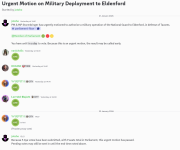
The motion proposed was not an inquiry, it was strictly a vote to authorize a military operation of the National Guard.
1770177161246.png
 
MOTION TO STRIKE

(4) No law precludes the executive branch seeking approval from the legislative branch on this issue.
As shown in the above screenshot the motion was strictly a motion to "authorize a military operation". If the MoS was submitting an inquiry parliament would've answered to a inquiry vote, not a deployment vote
 
Response To Motions

Your Honor, the point of including information in a complaint answer is that it is going to be used later in the Defendant's case. We respect your ruling on the Ministry of State's authority, but these are relevant facts and legal arguments. You have previously explained how answers to a complaint work to Plaintiff in CV03:
As I have reiterated in other cases, an answer to a complaint is the Defendant's initial position with respect to the allegations asserted. Objections based on relevance, hearsay, and an overly argumentative statement are premature where the Defendant has not yet had an opportunity to present its full case. The Court cannot adjudicate disputed factual assertions at the pleading stage.
If Plaintiff insists on ignoring Your Honor's guidance, clearly stated to Plaintiff in another case, we must motion for sanctions, as frivolous motions to strike cause avoidable delays in trial.
 
Back
Top